



Diamond Carat: Understanding Diamond Weight
What is diamond carat?
Diamond carat is the unit used to measure the weight of a diamond. It is one of the most well-known characteristics used when describing a diamond.
One carat is equal to 0.20 grams, or 200 milligrams. Carat weight is commonly abbreviated as ct.
Carat can also be expressed in points, where one point equals 0.01 carat. For example, a diamond weighing 0.50 carat may also be referred to as a 50 point diamond.
It is important to remember that carat refers to weight rather than physical size. However, larger carat weights are generally associated with larger diamonds, which is why the two are often linked.
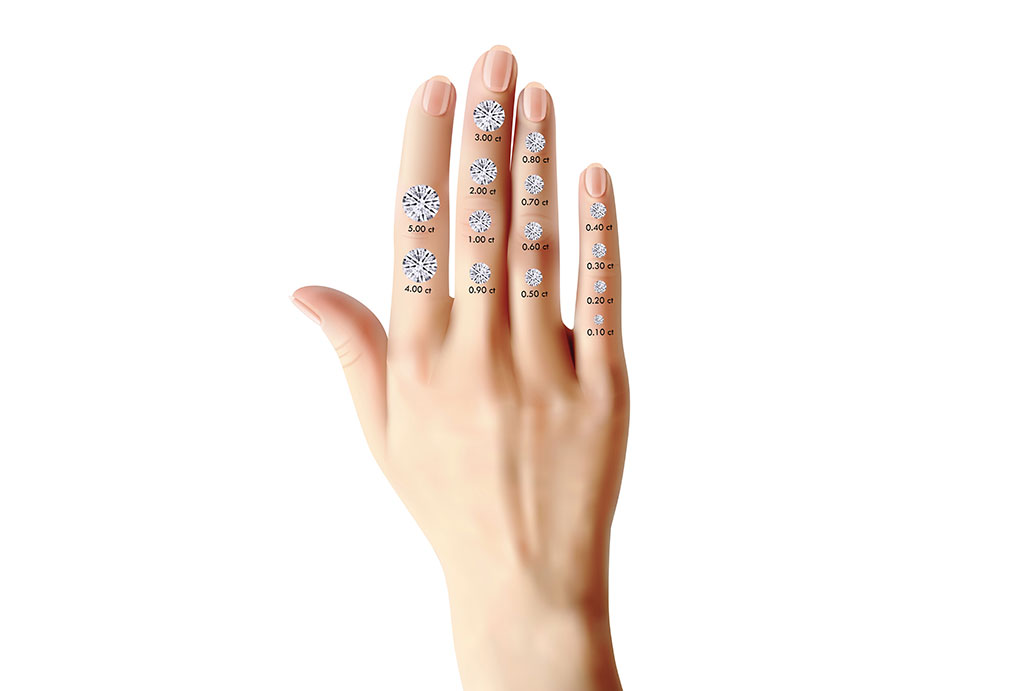
Does carat always determine diamond size?
Although carat measures weight, two diamonds with the same carat weight may not appear exactly the same size.
The proportions and shape of a diamond can influence how large it looks. For example, two diamonds weighing 0.50 carat could have slightly different measurements depending on their proportions.
Because of this, it is possible for diamonds with the same carat weight to vary slightly in visible size.
To help visualise this, many jewellery retailers provide diamond size guides that show the approximate measurements for different shapes and carat weights.
You can use our interactive diamond size guide below to help visualise how different diamond shapes and weights will look. The menu button to the left of the guide will also provide more information on each diamond shape and weight.
Diamond carat vs karat
Diamond carat should not be confused with karat, which is used to measure the purity of gold.
For example, gold jewellery may be described as 9 karat gold, which refers to the proportion of pure gold within the metal alloy. Diamond carat, on the other hand, relates only to the weight of a diamond.
Why diamonds become rarer as carat increases
Larger diamonds are naturally rarer than smaller stones. In fact, it can take approximately 250 tons of mined rock to produce a single 1 carat diamond.
Because larger diamonds are more difficult to find, their rarity contributes to their value. As a result, diamonds with higher carat weights are generally more expensive.
Carat weight and diamond shape
The shape of a diamond can influence how large the stone appears when worn.
Some shapes naturally cover more surface area, which can make them appear larger even if the carat weight is the same. For example, elongated shapes such as oval, marquise and emerald often appear larger than more compact shapes of equal carat weight.
This effect can be helpful for those who prefer the look of a larger diamond without necessarily increasing the carat weight.
How finger size can affect how a diamond looks
Finger size can also influence how large a diamond appears.
For example, a 1 carat diamond will often look larger on a smaller ring size than it would on a larger ring size. Proportion plays an important role when selecting the right carat weight.
Personal preference should also be considered. Some people prefer jewellery that stands out, while others prefer a more understated appearance.
Diamond carat and price
Carat weight often has the greatest influence on the price of a diamond.
Diamond prices typically increase exponentially rather than in a straight line. This means that doubling the weight of a diamond can increase the price several times over.
For example, if two diamonds have similar quality characteristics, a 1 carat diamond will usually cost significantly more than diamonds weighing 0.97 carat or 0.91 carat.
However, if other characteristics such as clarity or colour differ, a slightly smaller diamond with higher quality grades could cost more than a larger stone with lower grades.
Choosing the right balance between size and quality
When selecting a diamond, many people consider how carat weight fits alongside other quality characteristics.
Some buyers prioritise a larger diamond and are comfortable choosing lower grades in other areas. Others prefer a balanced approach that combines a moderate carat weight with strong overall quality.
There is no single correct approach. The right choice depends on personal preferences, priorities and budget.
Lab grown diamonds and carat value
Lab grown diamonds often provide the opportunity to select higher overall specifications at a more accessible price point.
Because lab grown diamonds generally cost less than natural diamonds, many buyers find they can choose a higher carat weight or stronger overall quality within the same budget.
You can learn more about the differences between natural and lab grown diamonds in our lab grown diamond guide.
How small carat differences can affect price
It is common for diamond prices to increase around popular weight thresholds such as 0.50 carat, 1 carat and 2 carat.
Choosing a diamond that is slightly below these weights can sometimes offer better value. For example, a 0.90 carat diamond may appear almost identical in size to a 1 carat diamond, yet the price difference can be significant.
In many cases, the visual difference between diamonds that vary by 5–10% in weight is difficult to notice once the diamond is set in jewellery.
How carat weight is displayed on jewellery
Carat weight can be displayed differently depending on the design of the jewellery piece.
For solitaire rings, the carat weight shown refers to the single centre diamond.
Some designs include additional smaller diamonds alongside the centre stone. In these cases, the carat weight of the side stones is usually listed separately in the product description.
For jewellery such as halo rings, three stone rings or certain earrings, the carat weight may be shown as T.C.W (Total Carat Weight). This represents the combined weight of all diamonds in the piece.
Design features that can affect how large a diamond appears
Certain jewellery designs can make a diamond appear larger than its actual carat weight.
For example, halo settings surround the centre diamond with smaller diamonds. This can create the visual effect of a larger centre stone.
Band width can also influence the overall look of the diamond. A thinner band can make the centre diamond appear larger, while a wider band may create a more balanced look.
Similarly, bands that taper slightly towards the centre diamond can draw attention to the stone and enhance its visual presence.
Choosing the right diamond carat
Carat weight is often the most visually noticeable of the diamond grading characteristics.
Some people begin by choosing their preferred carat weight and then selecting other characteristics that fit within their budget. Others prefer to prioritise overall quality and adjust the carat weight accordingly.
Ultimately, the best choice depends on personal preference and the balance you would like to achieve between size, quality and budget.


