Jewellery Hallmarking: What Hallmarks Mean
What is jewellery hallmarking?
A hallmark is an official mark stamped onto a piece of jewellery that confirms the purity of the precious metal used.
It is not possible to determine the exact purity of a metal simply by looking at or handling a piece of jewellery. For this reason, hallmarking provides an independent way to verify that the metal meets recognised quality standards.
In the United Kingdom, hallmarking is regulated under the Hallmarking Act 1973. This law makes it illegal to sell certain precious metal items above specific weights unless they have been independently tested and hallmarked.
When is hallmarking required?
Under UK law, jewellery made from precious metals must be hallmarked once it exceeds certain weight thresholds.
These requirements apply to the following metals:
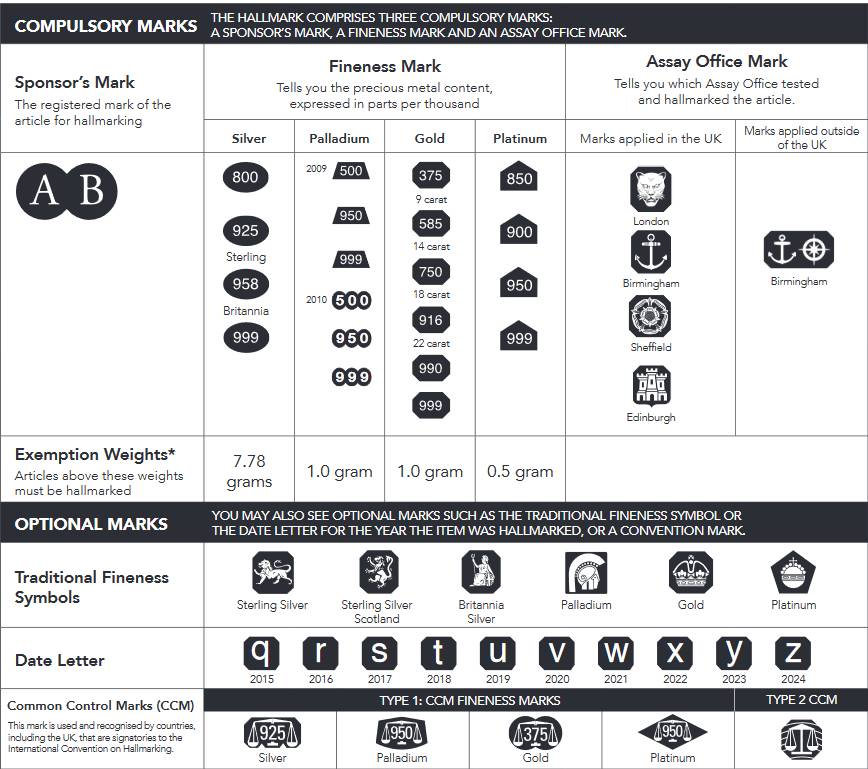
• Gold items weighing more than 1 gram must be hallmarked.
• Platinum items weighing more than 0.5 grams must be hallmarked.
• Palladium items weighing more than 1 gram must be hallmarked.
If a piece of jewellery falls below these weights, hallmarking is not legally required, although some manufacturers may still choose to apply one.
What information does a hallmark show?
A hallmark typically includes several symbols that provide information about the jewellery piece.
These marks can indicate:
• The type of metal used
• The purity of the metal
• The assay office that tested the piece
• The maker or sponsor mark
Together, these marks confirm that the jewellery has been independently tested and meets official standards.
Hallmark stamps for different metals
Each precious metal has its own hallmark symbol used to identify the type and purity of the metal.
The hallmark stamp applied to a piece of jewellery will vary depending on the metal used.
The table below shows examples of hallmark stamps used for different precious metals.